Helen Tandy, Founder Eco Communities
No to oil and gas. Yes to renewables, and yes to keeping the value of that renewable power right here in our communities.
For decades, our access to power has been dictated by a handful of national suppliers and the global price of fossil fuels. But look at what’s quietly happening in villages and cities across the UK, and a different pattern emerges: Energy Local Clubs turning surplus solar into cheaper bills for neighbours in Settle; Community Energy Birmingham using shared data to help local groups target the best rooftops for solar at scale; councils and combined authorities starting to back heat and power projects with real, joined-up funding. None of it is glamorous, it’s smart meters, spreadsheets, and volunteers giving up evenings for years on end. But it adds up to something oil and gas never offered communities: power, literally and figuratively, staying local.
That’s the shift Neston is now part of. Last week I sat down with the team from Neston Community Energy (NCE) again, this time joined by Mary from Energy Local and Will Pearson from Cheshire West and Chester’s Climate Emergency Team, to talk about something I hadn’t come across before NCE contacted me a few weeks ago: linking a community renewable energy project directly to an Energy Local Club.
So what is an Energy Local Club?
Energy Local is a community interest company whose mission is simple: help communities capture more value from small-scale renewable generation by encouraging people to use that electricity locally, rather than exporting it to the grid for very little in return.
Here’s the mechanism in plain terms: households and small local generators (think solar panels on a business roof, a community hall, or a local hydro scheme) join together as a “Club.” Smart meters record when Club members are using electricity and when the local generator is producing it. When the two line up, members get that power at an agreed, discounted local rate — cheaper than their normal tariff, but at a better price than the generator would get from exporting to the grid. Everyone wins: bills come down, local generators get fairer value, and more money stays circulating in the local economy instead of leaking out to national suppliers.
Energy Local has built up a well-developed onboarding framework to support new clubs: GDPR-compliant online member portals, standardised contracts, and pre-approved, verified promotional materials — all designed to keep clubs on the right side of regulation and to build trust with members from day one. New clubs are brought in through phased training, so people aren’t overwhelmed with technical detail before they need it.
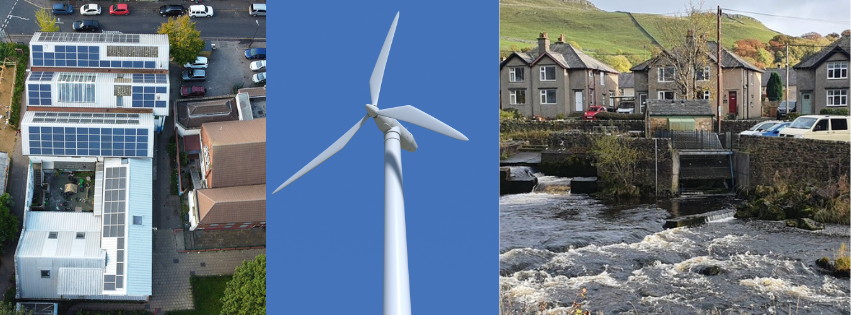
A good real-world example is Settle in North Yorkshire, where the Settle Energy Local Club grew out of an 80-member Action on Climate Emergency town group. It currently shares surplus solar power from a local furniture business, Slow Sofa, with local households, and is now working to bring an existing community hydro scheme into the Club too — which would add generation through the winter and overnight, when solar can’t help. It’s a small start, a handful of members so far — but it’s a genuine, working model of local people keeping power, and value, in local hands. This is exactly the kind of practical experience I’m hoping to learn from directly, with a meeting planned with Settle Community Energy shortly.
Who are Neston Community Energy?
Neston Community Energy (NCE) is a volunteer-run, member-owned community energy group based in the CH64 area, established as a co-operative in 2024. Like many community energy organisations, it’s structured so that any surplus it generates gets reinvested locally rather than paid out to shareholders.
NCE’s flagship project so far is the Clayhill Solar Park feasibility study, looking at whether the former landfill site on the Clayhill Industrial Estate, next to Neston Recycling Centre, could host a community-owned solar park. The group secured grant funding to carry out the study and has held open public meetings to share progress and gather local views. It’s this same site — and the challenge of finding the best way to capture value from its potential generation, that has led NCE to start exploring whether an Energy Local Club could be part of the answer.
What could NCE and a Neston Energy Local Club do for residents?
- Lower bills, without new costs to residents. Members would get a free smart meter and access to cheaper local electricity when it’s available.
- Fairer value for local generation. Rather than a local renewable asset exporting nearly all its output to the grid for a low return, a Club structure keeps more of that value within the community — for the generator and for consumer members alike.
- Genuine local ownership and agency. Prices are agreed by Club members themselves, not dictated from a distance.
- A tangible, visible decarbonisation story. It gives residents something concrete to point to — “our solar panels are powering our neighbours’ kettles” — which tends to build far more support for further climate action than abstract carbon targets do.
- Support that grows with the Club. Early members are likely to be those most able to manage the switch confidently, but the aim over time is to bring in a wider range of residents, including those who’d benefit most from lower bills.
- A foothold for further community energy investment. Once a Club is established and trusted, it becomes much easier to build the case for further local generation down the line.
NCE have approached me to help them with the community engagement part of bringing an Energy Local Club to Neston.
How can we build community energy in the new combined region?
Neston shouldn’t be working on this alone, and it doesn’t have to. There’s already a good base of community energy activity across the wider area to build on:
Cheshire West and Chester: Neston Community Energy, Chester Community Energy and Ashton Hayes Community Energy CIC.
Cheshire East: Dane Valley Community Energy (a hydro project near Congleton)
Warrington: Lymm Community Energy and Warrington Community Energy.
That’s a real cluster of groups, technologies and experience already spread across the patch, but from what I’ve found, most are working largely independently of one another, each rediscovering the same funding routes, grid connection headaches and governance challenges on their own.
My suggestion: bring these groups together now, before the new Cheshire and Warrington Mayoral Combined Authority is fully up and running, and agree collectively what community energy needs from the incoming devolved region from next year. That could mean a shared ask for a dedicated community energy fund or coordination role within the Combined Authority, shared access to grid and substation data so groups aren’t all paying separately for the same information, and a shared voice when the Authority’s economic strategy is being shaped. A joined-up sector with a clear, common set of asks will get taken far more seriously than a dozen villages and towns each turning up separately with their own solar park proposal.
For me its more meetings about Energy Local Clubs and possibly a 6 months project to see how it could work in Neston. Interested in this area see what else is going on around the UK…
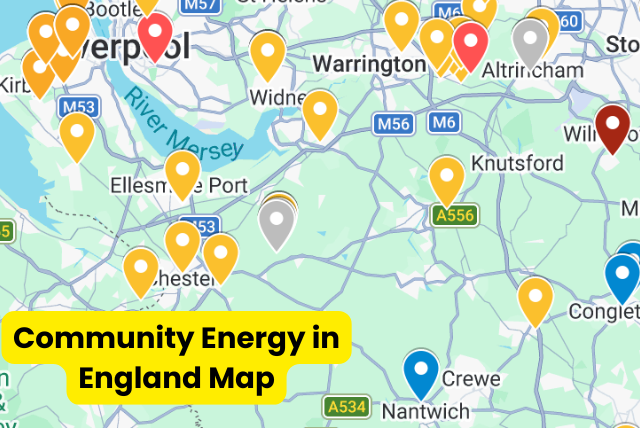
View the Community Energy England Map – National map – Community Energy England
- Bristol Energy Cooperative: of the UK’s over 500 community energy groups, Bristol is one of the most successful and longest-running. Founded in 2011, it manages 13.4MW of installed generation capacity, 12MW of it solar, across 15 rooftop projects and two ground-mounted solar farms, funded through community share offers and, more recently, a partnership with Triodos Bank.
- Westmill Solar Co-operative (Wiltshire/Oxfordshire), comprising 1,500 members, made up of 20,000 photovoltaic panels spanning over 30 acres, it was the UK’s first and, in 2012, the world’s largest cooperatively-owned solar park. More historic than cutting-edge now, but the one most people cite as the “grandparent” of UK community solar co-ops.
- Egni Co-op in Swansea, the largest rooftop solar cooperative in the UK, with 4.3MWp installed across 88 sites in Wales, including schools and community buildings, with surplus reinvested into climate education. Good example of a rooftop-focused (rather than solar-farm) model.
- Baywind Energy Co-operative in Cumbria, one of the very earliest, formed in the 1990s to buy wind turbines; part of the wider Energy4All family of co-ops.
- Energy Local are themselves a Co-operatives UK member, supporting around nine energy co-op “clubs” across the UK, including one in Brixton where members get electricity at 6.5p a unit.