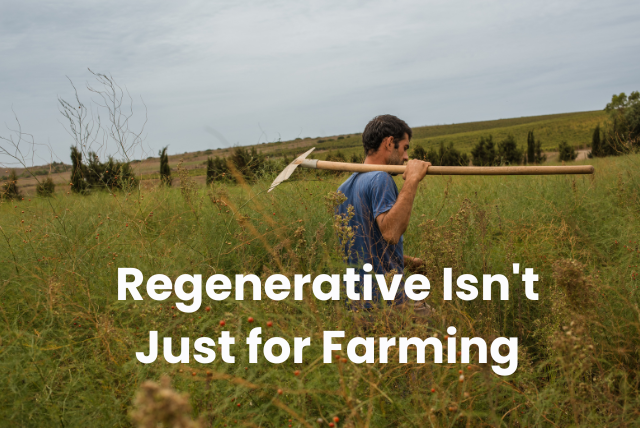
On Saturday 31st October, we have a stall at the Cheshire Biodiversity & Regenerative Food Festival by Regenerative Foods, a day dedicated to regenerative, organic and agroecological food production, nature and landscape regeneration, and heritage seeds and gardening. It’s the kind of event where “regenerative” gets talked about a lot, usually in relation to soil, seeds and growing methods.
But regenerative thinking doesn’t stop at the farm gate. It applies just as much to how organisations like ours are run, and that’s something worth talking about at our stall this year.
Beyond sustainability
A recent piece from Ethical Consumer, part of their ongoing series on challenging corporate power, made a distinction that’s stuck with us: sustainable businesses aim to minimise the damage they cause, while regenerative ones go further, actively working to repair and strengthen the natural and social systems they’re part of.
Sustainability is often about doing less harm. Regeneration is about actively leaving things better than you found them, soil, ecosystems, communities, and the relationships between them.
The article also makes a point that’s easy to miss: changing an organisation’s legal structure, becoming a co-op, a social enterprise, a CIC, doesn’t automatically make it regenerative. Structure matters, but so does culture: the values, habits, and everyday decisions that determine whether an organisation actually lives up to what its structure was designed to enable. Plenty of co-ops aren’t very co-operative in practice, and plenty of social enterprises drift from their founding purpose over time. The legal form is a tool, not a guarantee.
Where we fit in
We set Eco Communities up as a CIC (Community Interest Company) back in 2018 for exactly this reason, the structure locks in an asset lock and a community purpose, so the organisation can’t be quietly repurposed for private profit down the line. But we’ve always known the structure is only half the story. The culture we build, the projects we bring to the community is what actually keeps us regenerative in practice, not just on paper. Our Full Circle Refill and Reuse projects are run on volunteer time, we keep the costs of refill low to support communities in a time when we are thinking about the pennies but want to do the right thing still.
That’s an ongoing process, not a box we’ve ticked. As we think about scaling up, taking Refill into schools as an education project, and potentially spinning out our extra retail activity into a separate company, the questions the article raises are exactly the ones we’re sitting with: Is what we’re building aligned with why we started? Are the systems and habits we’re putting in place going to support that purpose, or quietly work against it?
Come and talk to us about it
If you’re at the festival on the 31st, come find our stall. We’ll have our usual refill and reuse offering, but we’re also happy to talk about the less visible side of regenerative work, the organisational choices behind it, and what we’re still figuring out. Regenerative food and regenerative business aren’t separate conversations; they’re the same conversation, just at different scales.
Source: Anna Clayton, “Regenerative businesses for the future,” Ethical Consumer, 11 August 2026.