A Weekend Journey That Tested My Faith in Rail
Helen Tandy, Founding Director Eco Communities
I have some extra time off this week, for some it would be a little breathing space, for me it is time to catch up on what I would have done over the weekend planning for Chester Green festival. We had a wonderful weekend away to see Paddington the Musical, sons kind Christmas gift. It was brilliant. The journey there and back? Not so much.
I’d done my bit for the planet. I’d convinced my husband to leave the (fairly new) EV at home and trust the railways for a Reading trip to stay with family. Public transport: the greener choice, the smarter choice, the choice I always advocate for. And the rail companies threw that right back in our faces.
The weekend was my husband, son, and me My son got on in Manchester direct and we were to join him in Stafford. The train was so busy on the downward journey with people sitting down in the door areas we couldn’t even get near our son.
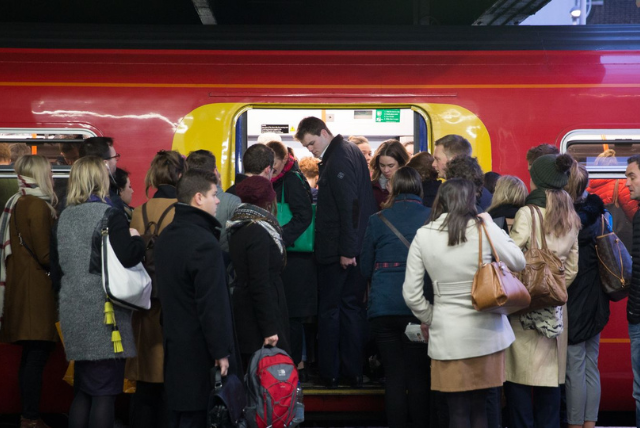
Going back my son was heading to a direct train to Manchester and we’d pre-booked seats, I’d had this lovely vision of us all sitting together at our reserved table. Of course, the train was so packed that we couldn’t even reach it. People were crammed down the isles and in the doorway areas. Conductors shouting people to move down the isle to get more people on. This was a train from Bournemouth and so lots of luggage. We couldn’t get near our booked seats? Taken, not through any malice, just the chaos of a system at breaking point.
The three of us stood for nearly two hours on the first train. We finally got seats somewhere around Birmingham. The overcrowding was so severe that every stop was taking longer than it should, delays were compounding, and we missed our connection at Stafford. What should have been a straightforward one-change journey turned into three changes. Three. I’ll let that sink in.
As many of you know, I’m dealing with some health stuff at the moment. Standing for that length of time wasn’t just inconvenient, it was genuinely difficult for me. And I wasn’t alone in struggling.
What stays with me most, though, is watching an elderly couple trying to disembark with a suitcase and a wheeled walking frame. I’d been slowly edging closer to the carriage doors at each stop in the hope of getting a seat, and my son was just behind me. I helped the gentleman get his luggage down from the rack, passed it along a chain of bodies to my son, who stepped off with it and helped them get through the packed corridor, and then of course found himself at the back of the queue trying to reboard. The couple did get off safely, and I got the impression that two young lads nearby had given up their seats for them earlier and were also helping. There are always good people in these situations. But they, and we, simply should not have to be in that situation in the first place.
I’ll be honest: I don’t think I’m going to persuade my husband onto a train again for anything beyond a central London trip.
So what’s actually going on?
This isn’t just bad luck or a one-off. Government figures show that during the morning peak on a typical autumn day in 2024, 22% of rail passengers at major cities in England and Wales were standing, around 168,900 people. Overcrowding is structural, and it’s been getting worse as passenger numbers recover post-pandemic.
The good news, if you can call it that, is that things are supposed to be changing. The government is in the middle of a significant shake-up of the entire rail network. The Railways Bill, reintroduced to the Commons in May 2026, would create Great British Railways (GBR) — a single public body bringing together most passenger train operators in England and Network Rail, which manages most of the infrastructure. It would also create a strengthened passenger watchdog. House of Commons Library
In practice, the nationalisation is already rolling. West Midlands Trains moved under state control on 1 February 2026, followed by Govia Thameslink Railway on 31 May 2026. By mid-2026, the public sector will run eight in ten passenger journeys overseen by the Department for Transport
On fares, there’s been one genuinely positive move: the government has announced a freeze on regulated rail fares in England for 2026, rather than the usual inflation-linked annual increase.
On compensation, things are shifting too. Claiming for train delays is set to be simplified — Delay Repay will move into one unified system, and you’ll be able to claim through third-party retailers like Trainline, not just directly through the train company. Currently, passengers have to navigate different systems run by 14 separate train companies, which often leads to frustration. The Campaign for Better Transport has welcomed this change as exactly the kind of joined-up thinking that Great British Railways needs to deliver.
The Campaign for Better Transport has highlighted that enabling access to Delay Repay through all retailers represents the kind of cross-sector collaboration important for the potential success of Great British Railways.
But here’s the thing.
All of this is structural reform. It’s promising, and I genuinely support the direction of travel (no pun intended). But nationalisation doesn’t automatically fix overcrowding. It doesn’t conjure extra carriages out of thin air. Transport experts have noted that while public ownership doesn’t guarantee immediate service transformation, it does give the government direct control to address punctuality, capacity and passenger experience.
In the meantime, people are still standing for hours on trains they’ve paid good money for. Elderly passengers with mobility aids are still having to rely on the kindness of strangers just to get off at their stop. And people like me, with health conditions that make prolonged standing difficult, are left hoping for the best.
We made the right choice taking the train. The system let us down. And until things actually improve on the ground, not just in legislation — convincing people to choose rail over the car is going to remain an uphill battle.
I’d love to hear your experiences in the comments.
Are you still choosing rail?
Have you claimed Delay Repay?
And do you think nationalisation will make a real difference?