At Hoole Green Festival, AJ Cakewell from Peckforton Dairy shared a deeply practical and quietly radical story about how a traditional family farm has been reshaped by changing markets, ecological limits, and a growing commitment to animal welfare and circular farming.
What emerged wasn’t a story of instant transformation, but of layered, incremental decisions — each one responding to economic pressure, environmental concern, or a simple question:
“Can we do this better for the land, the animals, and the people who drink the milk?”
From cheese to milk — and back again
In the early 20th century, the farm, like many others in Cheshire, produced cheese. It was a practical necessity, cheese stored and transported better than liquid milk at a time before reliable refrigeration and modern logistics.
But by the 1930s, that changed. Transport improved, markets expanded, and the farm shifted away from cheese into bulk milk sales.
For decades, that model worked, until volatility in global milk prices exposed its fragility.
After a major price crash in 2016, the farm began selling raw milk directly from the farm gate. Demand was strong, but regulation limited how far this model could go.
That tension — between local demand and structural constraints — became the catalyst for reinvention.
A circular rethink: glass, grass, and low inputs
One of the most visible changes came in packaging. In 2020, Peckforton Dairy introduced a glass bottle system for milk sales.
The system is simple but powerful: bottles are reused locally, washed, and recirculated.
Around 2,500 plastic bottles a week are avoided through this approach.
But the packaging shift sits inside a much larger system change.
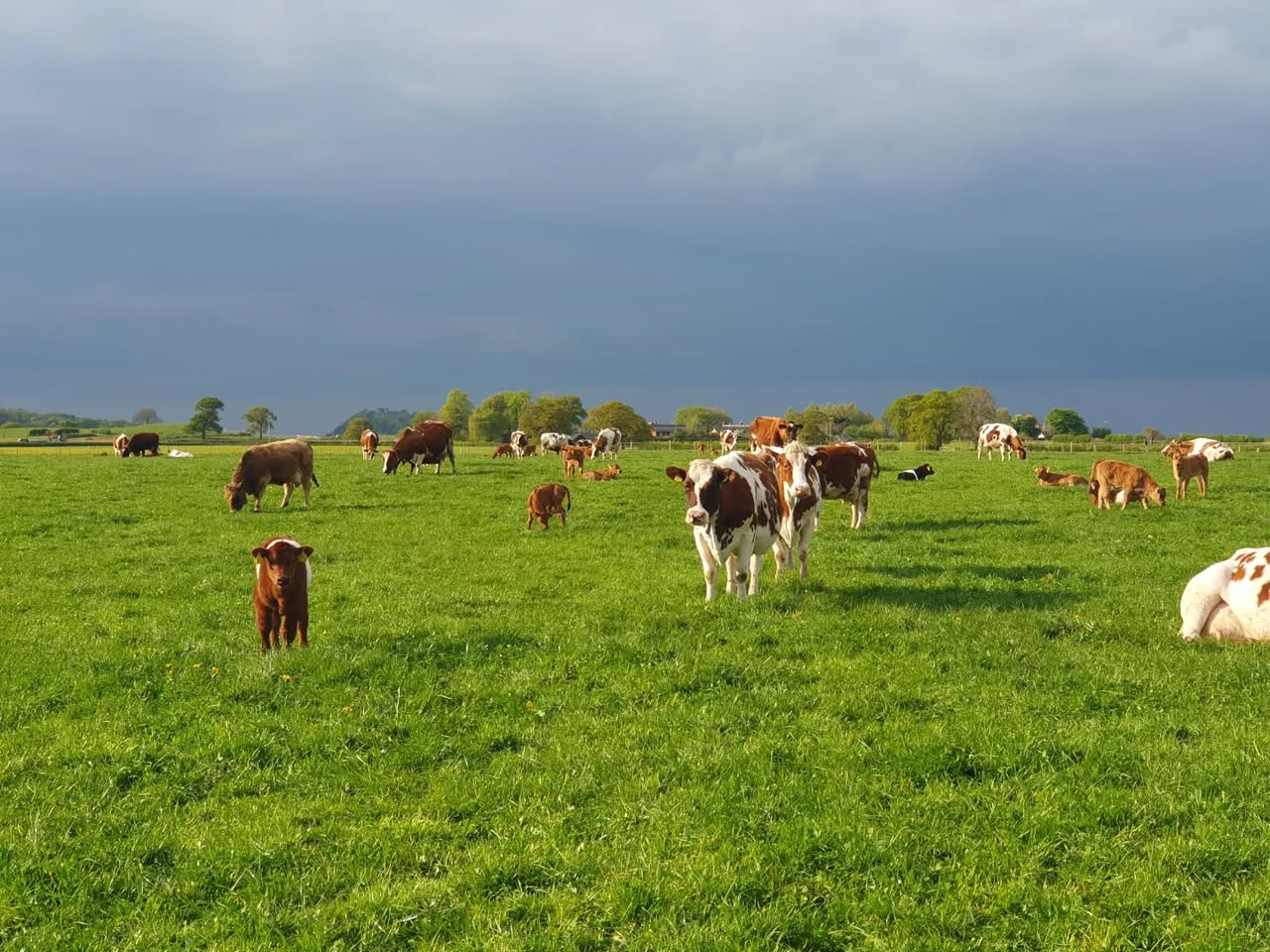
Since 2016, the farm has stopped using artificial fertilisers entirely. Instead, it relies on clover-rich pastures to fix nitrogen naturally, alongside diverse herbal leys introduced in recent years.
This reduces exposure to volatile global fertiliser markets, but also reshapes the ecology of the land, increasing biodiversity and soil resilience.
The cow-calf system: rethinking dairy relationships
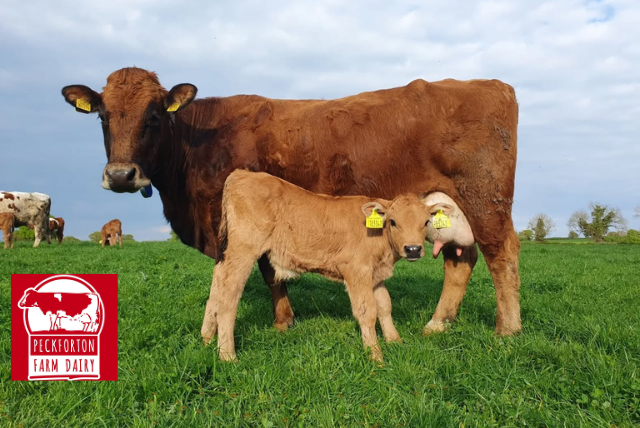
Perhaps the most significant shift has been the move towards a cow-calf dairy system.
Starting in 2021 with just a few animals, the system has now been expanded across the herd.
In this model, calves remain with their mothers for several months rather than being separated shortly after birth — a major departure from conventional dairy practice.
The farm reports a number of outcomes:
- Improved calf health and vitality
- Reduced antibiotic use and lower incidence of mastitis
- More stable cow behaviour and reduced stress
- Stronger long-term herd relationships
Weaning is handled gradually using “weaning flaps,” allowing the bond between cow and calf to reduce slowly rather than abruptly.
There are trade-offs. Milk volumes are lower and more seasonal, and production is less uniform. But this is balanced by direct-to-consumer sales and stronger product differentiation.
Milk quality, not just quantity
One of the more interesting observations shared was how milk composition shifts under this system.
With a grass-based diet and calves taking part of the milk supply, the remaining milk tends to be naturally higher in butterfat and protein.
In other words, less output — but potentially higher quality.
This challenges a long-standing assumption in dairy systems that efficiency is purely about volume.
Returning to cheese — and closing loops
The farm is now also returning to its roots: cheese-making.
Plans are underway to restore an old farmhouse dairy to produce small-batch soft cheeses and traditional Cheshire cheese, reconnecting the farm with its historical identity.
Alongside this comes another circular innovation: pigs fed on whey and dairy byproducts from cheese and butter production, a practice common on the farm until the 1960s.
Together, these systems begin to close nutrient loops:
- Milk becomes cheese
- Cheese creates whey
- Whey feeds pigs
- Waste becomes input
Nothing is truly discarded — it is redirected.
Economics of resilience
A recurring theme in the talk was cost stability.
By reducing reliance on external inputs, fertilisers, concentrates, packaging materials — the farm reduces exposure to global price shocks.
Instead of competing in volatile commodity markets, it builds resilience through:
- Direct sales
- Local supply chains
- Low-input grass systems
- Product diversification
This is not framed as nostalgia or romantic farming, but as economic adaptation.
A wider movement emerging
Peckforton Dairy is not operating in isolation.
Around 30 farms in the UK are now experimenting with cow-calf dairy systems, supported by European research networks and farmer-to-farmer knowledge exchange.
Documentaries and farm visits are accelerating interest, particularly among farmers questioning whether industrial dairy systems are the only viable model.
There is no single blueprint emerging — but there is a shared direction of travel:
towards systems that are lower input, more relational, and more ecologically embedded.
What this means for Eco Communities
The Peckforton story sits at the intersection of several wider themes:
- Circular economy thinking applied to food systems
- Animal welfare as a design principle, not an afterthought
- Local
 resilience in the face of global market instability
 - Ecological farming as economic strategy, not just environmental choice
It also raises important questions:
- What do we value more — efficiency or resilience?
- How do we account for animal wellbeing in food systems?
- Can smaller, locally embedded systems remain economically viable?
Closing reflection
What makes this sto
ry powerful is not that it presents a finished solution, but that it shows a farm in active transition — experimenting, adjusting, and rebalancing. You will see Peckforton milk used by lots of cafes and businesses in Chester, including Hoole Community Centre.
Rather than scaling up industrial logic, it is scaling down inputs and scaling up relationships: with animals, with land, and with local communities.
In a time of climate uncertainty and ecological pressure, that shift may be one of the most important transitions agriculture can make.