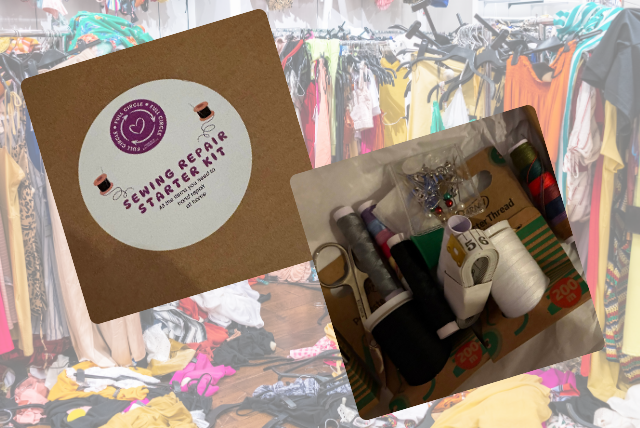
Helen Tandy, Founding Director
I still remember standing at a sewing machine at school, feeding fabric through under the needle, half-terrified I’d sew straight through my finger. Sewing and cooking were compulsory back then, everyone did both for a period, before you were allowed to choose /drop Home Economics Cooking or Home Economics Clothing to take further at O level. I took sewing and used to make a lot of my own clothes many years ago.
Talk to most people under about forty today, though, and that memory doesn’t exist. Somewhere between then and now, sewing quietly disappeared from most of our lives — not banned, not decided against, just squeezed out. And in its place, a different habit grew: when something’s broken, you don’t fix it, you replace it.
A generation without the basics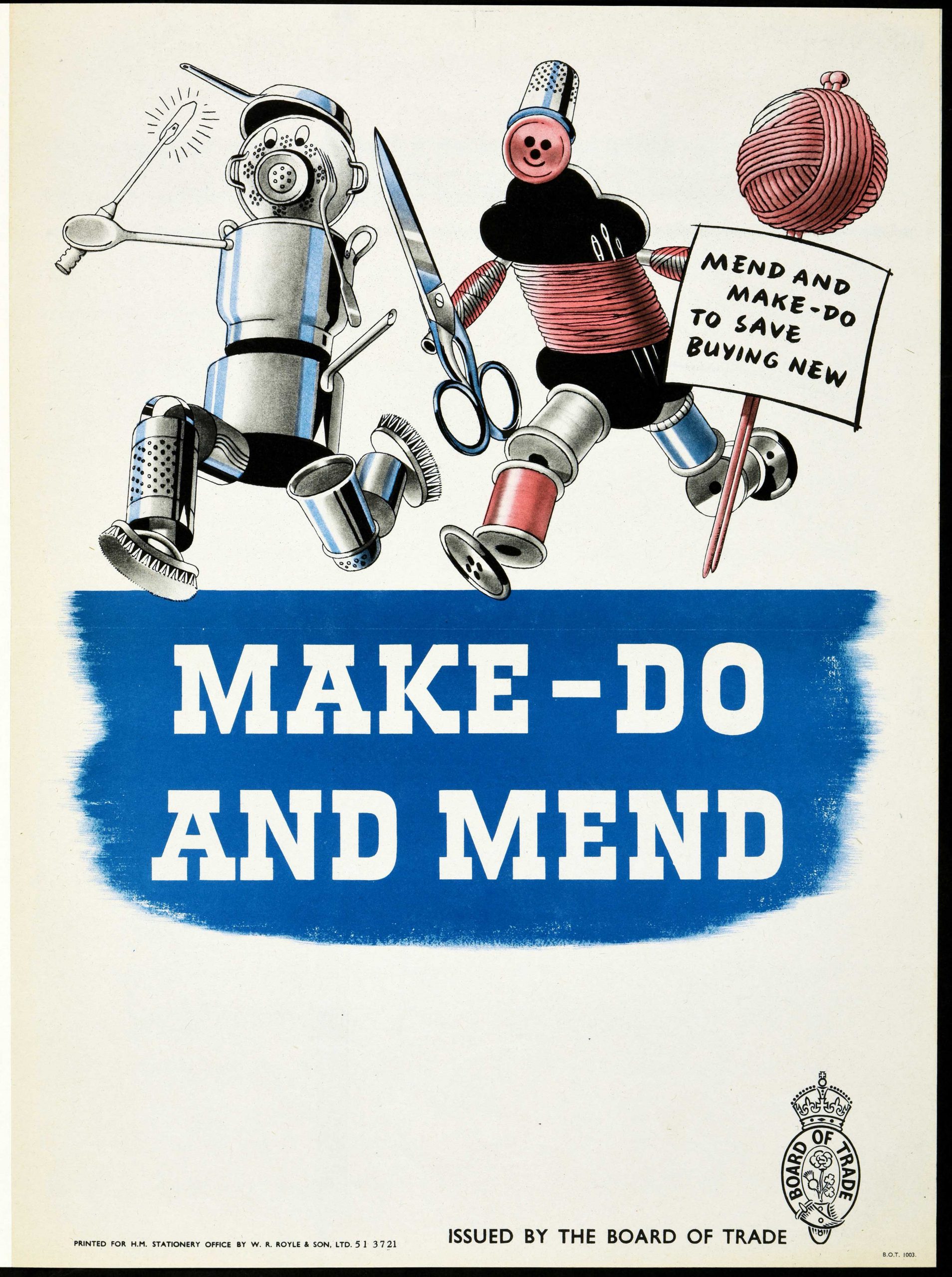
Textiles has technically been part of the school curriculum since 1989, folded into Design & Technology rather than standing alone as “Home Economics.” On paper, every child is meant to get some exposure to sewing through primary and into the early years of secondary school. In practice, it’s patchy. Some schools treat it as a proper strand of D&T; others fold it into art and design as something creative rather than practical, and by GCSE, textiles isn’t offered everywhere at all. Budgets are tight, specialist teachers are in short supply, and a subject that was once seen as a basic life skill has slipped down the priority list.
The result is a generation of adults who never learned how to sew on a button. Not because they couldn’t — nobody ever really struggles with it once they’re shown — but because nobody showed them. I have the poster opposite on my Office/Making Room Wall. 10 Top Tips For Winning At World War 2 ‘Make Do And Mend’
Make Do and Mend” was a British government campaign during WWII encouraging people to repair, reuse, and creatively adapt clothing to cope with rationing and shortages.
Where that gap leads
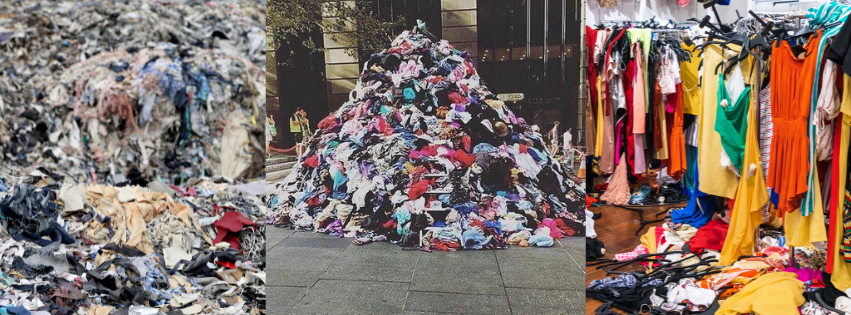
Meanwhile, the clothes we buy have got cheaper, faster, and much easier to throw away. The UK sends around 300,000 tonnes of clothing to landfill or incineration every year, more per person than anywhere else in Europe. Each of us throws away roughly 3 kilograms of textiles a year on average. Globally, something like 92 million tonnes of clothing waste is generated annually — the rough equivalent of a full rubbish truck being landfilled or burned every single second.
Most of that clothing isn’t beyond saving. A huge proportion of what ends up in the bin has nothing structurally wrong with it — a missing button, a dropped hem, a small hole at the elbow or toe. The kind of thing that, a couple of generations ago, would have taken ten minutes with a needle and thread. Now, without the skills or the confidence to try, it’s simpler to bin it and buy another one.
That’s not really a criticism of anyone — it’s just what happens when a skill stops being passed down. You can’t fix what you were never taught to fix.
Why we made the kit
This is exactly the gap we wanted to close with our Home Sewing Repair Kit. It’s a small, simple box, needles, cotton, pins, a tape measure, scissors, buttons, hemming tape, a thimble, elastic and safety pins — built around the handful of repairs that cover almost everything that goes wrong with everyday clothes.
Alongside it, we’ve put together a short how-to guide covering the basics: sewing on a button, fixing a hem, darning a hole, and a few other quick fixes, each paired with a video if you’d rather watch than read. Nothing in it assumes you’ve ever picked up a needle before. The whole point is to hand back the confidence that got lost somewhere along the way — not a mending obsession, just enough to keep a favourite jumper or a good pair of trousers out of the bin.
Every repair you make yourself is one less item added to that pile of 300,000 tonnes. It’s a small thing. But small things, done by enough people, add up to something real.
From needle and thread to sewing machines
A needle and thread will fix most things, but some repairs and alterations really do need a machine — and buying one just to shorten a pair of trousers or fix a seam is a big outlay for something you might use twice a year. So we’re taking the same idea behind the kit and scaling it up.
Earlier this year we secured funding for a set of sewing machines, and this September we’re launching workshops to go with them. Over a series of weekly lessons, you’ll learn how to use a machine properly and confidently. Once you’ve been trained on it, that same machine can then be borrowed — much like a library book — whenever you actually need it, rather than sitting unused in a cupboard for 50 weeks of the year.
We actually got the first taste of this at Chester Green Festival, where the loan scheme had its soft launch alongside a basic sewing workshop, a free circular workshop on visible mending and crochet with Emma Summerscales (@emma_summerscales), and a session with Suze Schneider. It was a brilliant reminder of just how much appetite there is for these skills once people are given the chance to try them.
It’s the same principle as the repair kit: give people the skills and the tools at the point they need them, without the expense and waste of everyone owning a machine of their own.
Workshops are set to start in the second half of September. Register your interest below and we’ll be in touch with dates and details as soon as they’re confirmed.
If you’d like a kit of your own, or want to teach someone else the basics, get in touch, we’d love to help more people rediscover a skill that really shouldn’t have gone missing in the first place.
Read our A beginners guide to simple sewing repairs.
Simple Guide to Sewing repairs by Claire Binns