Helen Tandy, Founder Eco Communities
The UK is one of the most nature-depleted countries in the world, and the numbers make uncomfortable reading. In 2020, the government committed to protecting and managing at least 30% of land for nature by 2030, the “30by30” target. With that deadline now only four years away, official figures put England at just 7% properly protected: less than a quarter of the way there.
A new government delivery plan published last week was meant to reassure critics that things would speed up. It hasn’t landed well. MPs on the Environmental Audit Committee say it introduces no new legal protections, and conservation charities have dismissed it as a rebrand of existing ambitions rather than a genuine plan for delivery.
Guy Shrubsole’s verdict
One of the sharpest critics of the plan is Guy Shrubsole, a researcher, campaigner and author who I know from his work at Friends of the Earth also worked for Rewilding Britain and DEFRA, and co-founded the Right to Roam movement. He’s the author of three bestselling books on land and nature in Britain: Who Owns England?, The Lost Rainforests of Britain (winner of the 2023 Wainwright Prize) and, most recently, The Lie of the Land, winner of the 2025 Wainwright Prize for Conservation Writing.
Shrubsole’s argument is that the government’s plan leans almost entirely on landowners volunteering to help, rather than requiring it — and that with no new Sites of Special Scientific Interest created since 2023, the “backbone” of the 30by30 target isn’t being reinforced at all. His conclusion: national delivery so far has been too passive to match the scale of the crisis.
Cheshire was starting from a worse position, but is now doing something about it
Here’s the part that matters most to us. Cheshire isn’t just facing the same national shortfall — by its own account, it’s starting from a worse baseline than most of the country, having become one of the most species-depleted counties in England. That’s not us being self-critical; it’s the assessment in Cheshire and Warrington’s own Local Nature Recovery Strategy (LNRS), approved by local leaders in November 2025.
What makes Cheshire’s position stronger than many other regions right now is that this strategy exists at all, in finished form. It’s a full 10-year plan (2025–2035), with detailed local habitat mapping and priorities across woodlands, grassland, watercourses, peatland, farmland and urban nature — while many other counties are still consulting or piloting theirs. Having an approved, published strategy this early puts Cheshire ahead of the curve on turning ambition into an actual delivery framework.
The Chester Wetland, a project close to home
One of the clearest examples of that ambition in action is the Chester Wetland, taking shape in the Countess of Chester Country Park. It’s the brainchild of wetland scientist Professor Christian Dunn of Bangor University (Eco Communities’ own co-founder with me, though he’s no longer directly involved in running the organisation) he is working alongside Andy Scargill of the park’s Friends group. What started as an idea in a pub back in 2020 has grown into a fully-funded, 23-hectare scheme that recently secured planning permission from Cheshire West and Chester Council.
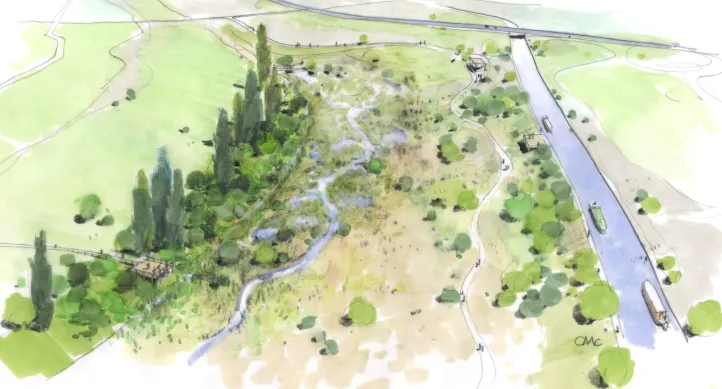
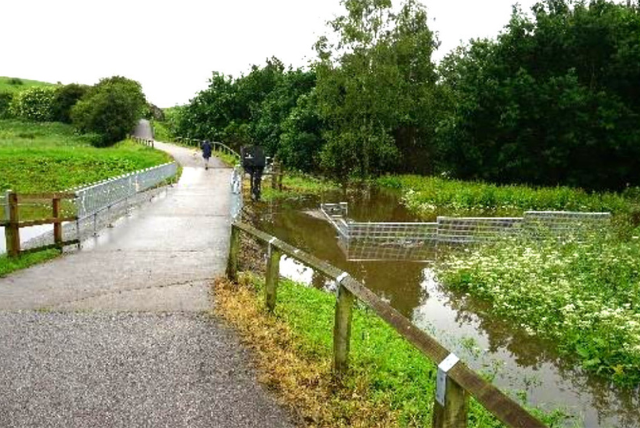
The finished site will bring together reedbeds, shallow pools, treatment wetlands and a wet meadow, a habitat type that’s become genuinely rare in the UK — right next to the hospital, filtering pollution, easing flood risk on nearby paths, and creating a real boost to local biodiversity. It’s backed by more than £322,000 from the Environment Agency and the council, £250,000 from Chester Zoo’s Networks for Nature initiative, and a further £500,000 from local biodiversity funding, and it’s already been recognised at national industry awards.
You can read the full project breakdown, including delivery status and funding still being sought — on the Cheshire Local Nature Partnership’s Chester Wetlands listing.
More large-scale work across Cheshire, and beyond
The Chester Wetland isn’t an isolated success story. The Mersey Forest, working with Chester Zoo and the Environment Agency, has this year planted over five hectares of new native woodland on Chester Zoo’s own land — 5,200 trees, on top of nine hectares planted in 2024, explicitly tied into the Cheshire LNRS and Chester Zoo’s wider Networks for Nature project. Mersey Forest’s other Cheshire work includes natural flood management schemes and woodland management plans covering 700 hectares of previously undermanaged woodland.
Further afield, the National Trust has completed its biggest-ever nature recovery project across Cheshire and Greater Manchester, restoring green spaces, creating wildflower meadows, and planting thousands of trees and hedgerows at sites including Dunham Massey, Quarry Bank, Lyme and Alderley Edge — all part of the same broader push to make nature recovery real on the ground, rather than just a target on paper.
Where you come in
All of this is exactly the kind of work the Wilder Cheshire Awards exist to celebrate. Now open for entries across ten categories — from Young Wildlife Champion and Wilder School to Landscape Stewardship and Species Recovery — the awards are a chance to recognise the people, projects and organisations already doing what national policy keeps promising but struggling to deliver.
Entries close 13 September 2026. Find full details and enter at www.wildercheshireawards.co.uk.
National plans may be stalling. Cheshire, it turns out, isn’t waiting for them.