A Growing Regional Debate Across Cheshire and Beyond
Back in January, we explored the proposed Peak Cluster carbon capture and storage (CCS) project and what it could mean for Cheshire. Since then, the discussion has widened significantly. What was once seen as a regional infrastructure plan is now part of a much larger debate spanning multiple counties—and raising national questions about how the UK reaches net zero.
Importantly, Cheshire is not alone. Communities across Derbyshire, Staffordshire, and the Wirral are now part of the conversation, as the proposed CO₂ pipeline would cross all of these regions on its way to offshore storage.
What is the Peak Cluster project?
The Peak Cluster project aims to capture carbon dioxide emissions from cement and lime production in the Peak District. The captured CO₂ would then be transported via pipeline through several counties before being stored under the Irish Sea in depleted gas fields.
Supporters describe it as a major step in decarbonising heavy industry, while critics question its environmental impact, cost, and long-term consequences.
Why the debate has intensified
Since early discussions, opposition and concern have grown. This is largely due to three key factors:
1. Wider geographic impact
The pipeline is not confined to one area. It affects:
- Derbyshire (industrial capture sites)
- Staffordshire (transport corridor)
- Cheshire (pipeline route)
- Wirral and surrounding coastal areas (terminal and offshore storage connection)
This has shifted the conversation from a local issue to a regional one.
2. National visibility
Recent media coverage and public consultation activity have brought the project into broader public awareness. As a result, it is now being discussed as part of the UK’s wider carbon capture strategy.
3. Growing questions about approach
Even among those who support climate action, there is debate over whether CCS is the right long-term solution or whether it risks locking in existing industrial systems.
The case FOR the project
Supporters argue that:
- Cement and lime production are extremely difficult to decarbonise without CCS
- The project could significantly reduce industrial emissions
- It may protect thousands of skilled jobs in key regional industries
- It helps the UK meet legally binding climate targets
- It avoids “carbon leakage” by keeping production in the UK rather than moving emissions abroad
From this perspective, CCS is seen as a necessary bridge technology while cleaner alternatives are developed.
The case AGAINST the project
Concerns raised across affected communities include:
- Environmental impact: disruption to countryside and farmland, potential habitat loss and ecological disturbance, long-term changes to rural landscapes
- Local disruption: construction activity across multiple counties, concerns about proximity of pipeline routes to homes and communities
- Cost and priorities: questions about public funding for industrial-scale infrastructure, debate over whether investment should focus more on renewables and demand reduction
- Strategic concerns: whether CCS prolongs reliance on high-emission industries rather than transforming them
- Consultation and trust: some residents feel information has been unclear or difficult to access, concerns that decisions are being driven nationally rather than locally
A wider regional issue, not just Cheshire
One of the most important shifts in the discussion is recognition that this is not a single-community issue.
Instead, it is a multi-region infrastructure project, meaning:
- Impacts are distributed across several counties
- Different communities experience different levels of disruption
- Decisions made in one area affect others downstream
This has led to growing coordination between community groups across regions.
🧭 Stakeholder Map: Who is involved?
Here is a simplified visual map show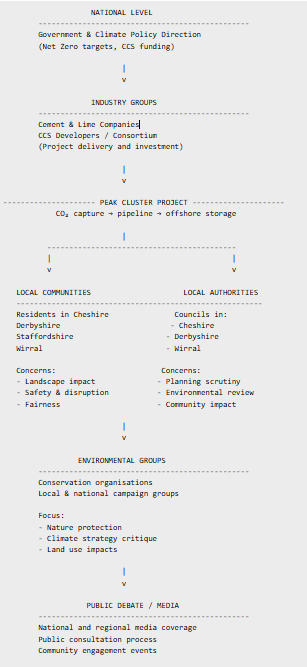 ing the main groups involved in the Peak Cluster debate and how they relate to the project.
“To understand the debate, it helps to map out who is involved. The Peak Cluster project isn’t just a local issue—it brings together government, industry, communities, and environmental groups, each with very different priorities.”
How to interpret the map
- The top level (national government and industry) drives policy and delivery
- The middle level (project + councils) manages planning and regulation
- The ground level (communities and environmental groups) experiences direct impact and raises concerns
- The media and public debate layer influences transparency and accountability
Final thoughts
The Peak Cluster project highlights a growing challenge in climate policy:
It is not just about whether we decarbonise—but how we do it, and who is most affected along the way.
As consultation continues, the key question for all stakeholders remains:
How can national climate goals be achieved while ensuring local communities feel informed, included, and fairly treated?